To get my story over with I should say that, like some adults who do not have a history of allergies, overnight I became highly sensitive to something, in this case deodorant. It was a normal morning about five years ago, getting ready as normal, putting on my usual (aluminum-containing) deodorant. After the final swipe, BAM, underarms swelled alarmingly and became red, painful and massively itchy. The area was so swollen I couldn’t put my arms down by my side. Ice, antihistamine, ibuprofen – nothing helped much. This weird and horrible reaction did not subside completely for two weeks. You read that correctly, two weeks.
So, thinking ‘wow, that was horrible so I must use a non-aluminium deodorant’, I tentatively rolled on one of those reassuringly expensive eco brands (I had a range of them already that I occasionally used). BAM, same reaction – but for three weeks this time. Miserable, sleepless and bewildered (not to mention a bit whiffy) I tried to find out why I had such an extreme reaction to something I had used since late childhood. I couldn’t get any answers from doctors, just shrugged shoulders and offers to do a patch test – no thank you! Nor was the Internet much help, except I did find a good deal of information on making one’s own deodorants. The latent chemist in me was intrigued.
Over time I have developed my own blend of spray-on deodorant – with a manly version too. If you dare to read on I’ll give you the recipe and more information about breast cancer and deodorant. And don’t worry, no photos of underarms…


There seems to be two main strands to the belief that deodorants cause breast cancer: 1) parabens in deodorants may cause cancer; 2) aluminum in deodorants/anti-perspirants may cause cancer. The latter tends to be most discussed and researched. Other peripheral issues abound relating to the inadvisability of blocking pores and the belief that microscopic cuts from shaving fast-track chemicals into our bloodstream.
As far as the paraben link goes, parabens are preservatives that happen to imitate the activity of estrogen on breast tissue cells, but at a very low level. To my knowledge human estrogen ‘overwhelms’ any effect paraben might have. It is thought that because parabens have been found in cancerous breast tissue that parabens may be responsible for the disease in some women. The studies have largely been dismissed by cancer charities and scientists due to other tissues not being sampled as well – basically they have no benchmark, no ‘control’ samples. It is likely that most anything that makes it into the bloodstream may show traces in cancerous – and non-cancerous – tissue. Nor was it established that any build-up was due to deodorant use, as parabens are also found in other products with which we can into contact. Many deodorants in the UK and US deodorants no longer use parabens – check the label or manufacturer’s website if you are concerned.
And then there is aluminum, or aluminium if you prefer. Like parabens, aluminum has estrogen-mimicking properties but it is used in deodorants to temporarily block the sweat glands. Bacteria in sweat is what causes odour, so blocking the source helps control odour. It has been thought by some that because many tumours are sited near the armpit that aluminum, and it’s duct-blocking and estrogen-imitating facets, may contribute to cancer over time. I’m summarising here, it’s a bit more complicated than that. In fact, breast tumours occur nearer the armpit because of the simple fact that there is more tissue in that area. The science blog at Cancer Research UK says it succinctly: more tissue = more cells. More cells = more things that can go wrong = higher chance of a cancer developing.
Like paraben studies, the studies that have looked at the aluminum-breast cancer link are thought to be flawed in various ways. Studies largely have not used healthy tissue or healthy people as controls. But one interesting 2003 study did raise the possibility of a link by examining the frequency of underarm shaving and deodorant use among 437 women who had had breast cancer. Age of breast cancer diagnosis was ‘significantly earlier in women who used these products and shaved their underarms more frequently. Furthermore, women who began both of these underarm hygiene habits before 16 years of age were diagnosed with breast cancer at an earlier age than those who began these habits later’ (cancer.gov). Although this is by no means a conclusive link it is a finding that gives pause for thought, and cause for further research.
Most breast cancer charities believe that more and better research needs to be done in this area. So far no one can say for sure that deodorants don’t have anything to do with cancer, just that most studies are a bit incomplete.
As a realist and quasi-scientist myself, I like proper science to inform my decisions. But it is hard to quieten my instinct that sticking a bunch of chemicals under my arms for years and years on end is perhaps not a good idea. So many of us avoid smoking, drinking too much and eating chemical-laden foods, that it makes sense to me that we should also avoid putting too many extra chemicals under our arms, on our body and on our face. There is much about cancer that we can’t control so it makes sense to me to control the things that we can, and not worry too much about the things that we cannot.
If you want more information about this topic, Cancer Research UK is good, as is the US site cancer.gov, which also holds this article from the American Cancer Society, the which I found a bit dismissive of peoples’ concerns. These sites also give references of scientific papers should you wish to investigate for yourself. I will monitor this issue and report back when the currently active studies report. In the meantime I give you my humble little concoction.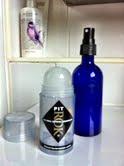
My homemade deodorant spray (and others like it) has potent anti-bacterial and ‘drying’ properties, and works very well under most circumstances. It doesn’t stop sweating but does reduce it somewhat and seems to neutralise the odour. I do Zumba a couple of times a week and my homemade deodorant seems to do the trick even in these trying circumstances. I have had no complaints from family or friends, and no exclusion zone has popped up around me post-exertion. But, I must admit, when I am very nervous about something the deodorant is less effective.
Other ways to keep more fragrant include bathing regularly (obviously), limiting spicy foods (but that would be sad) and wearing natural, breathable fibres. Strangely I find that in hotter temperatures I sometimes don’t even need deodorant, perhaps because the sweat is constant and ‘fresh’, while I also will be wearing plain cotton or linen. That might just be me, but I wonder if any of you have found the same to be true of yourself. (this article updated June 2013)


You will see that I have used vodka of all things as my preserving agent and overall bacteria zapper. You could instead use witch hazel, but this is hard to get as a pure product here in the UK. If you can get the witch hazel use it with the vodka. This seems to work best. Any nicks on the skin may sting – as with any deodorant – but it is temporary. You can find recipes that use baking soda and other powdery or waxy carriers and deodorisers but I have found them too ‘faffy’. Here are two good websites to explore if you want to explore other options: ecofriendlydaily.com and ehow.com.
The essential oils that I use smell nice to me and seem to work, but you can use most combinations that suit you. To check suitability for use on skin and for compatibility with other essential oils, check here with this rather comprehensive African website. They also advise on appropriateness with regard to such things as sensitivities, allergies, pregnancy and the like. You may read elsewhere that sage and clary sage are highly effective deodorisers, but I would not advise using them as they have too many contraindications. I am no expert so please do have a look at this and these two websites to make sure my combination is right for you: Are Essential Oils Safe? (University of Minnesota) and Tea Tree Oil: Science and Safety (from National Institutes of Health in the US) – please read before trying any homemade deodorant. You may also like to ask a qualified herbalist for their advice. Here also is an interesting, if not particularly balanced, article: 10 Reasons Why Store Deodorant Stinks, from The Healthy Home Economist.
Now to the recipes. You’ll notice I have also put together a chap’s version because my original one is a bit feminine for the average male. But you never know. My daughter really likes the manly one.
For both deodorants use a dark glass bottle with appropriate sprayer (prevents degrading of the oils). For mine I go to Neal’s Yard where they sell their beautiful blue bottles as recycles for 50 pence, or something like that. The sprayers are new and cost about £1 each. Here’s the US website.
For the essential oils, there are many places to find them but I prefer Neal’s Yard Remedies (this is the store finder page), Abbey Essentials and Tisserand. Whatever you end up getting make sure it is a pure oil rather than a blended oil, otherwise you are only getting a fraction of what you need for the deodorising and drying effects. Always keep homemade essential oil-based deodorants in a cool and dark place. The oils I’ve chosen are easily available in most places that sell such things, but experiment with some of the less common ones if you like their aroma.
Kellie’s Original Deodorant
A More Manly Deodorant
For both of these deodorant sprays, add the oils directly into your glass bottle and top up with vodka and witch hazel. Close tightly with the sprayer and cap. Shake well before each use to redistribute the oils. You may also use distilled water in place of the witch hazel but it dries less quickly on the skin.
I don’t think I can sign off without saying something about food, even if it’s not mine. I’m not much for convenience food as I have the time and energy to do things from scratch, and it’s my job to be a real food cheerleader, but on your behalf (ha ha) today I slurped down some lovely packaged noodles from Clearspring. At my nutrition workshops I advise those that are going through cancer treatment to find a few decent convenience foods to keep by in case they are unable to cook. Of course it is preferable to have homemade soups, casseroles, smoothies and the like but sometimes opening a carton or package is the best that can be done.
This little packet of the familiar ramen noodles is reassuringly free of additives, weird stuff and the noodles aren’t fried before drying. In fact, other than being a little bland (which is perfect during treatment) it was quite tasty. I supplemented it with scavenges from the vegetable drawer – spring onion, shiitake, carrot, while also adding my beloved umeboshi paste for a sour kick. I got it at Waitrose, but Clearspring is found in other UK shops too. If you have a healthy-ish storecupboard find that you would recommend for those going through treatment, do let me know. If I get enough recommends I will make up a list and stick it in the Nutrition and Cancer section as an easily-found page.